|
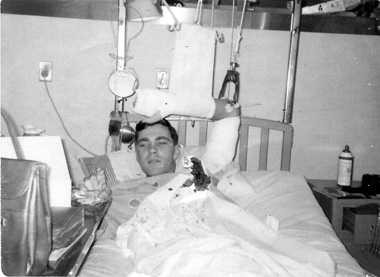
Cpl. Noah Gibson, recovering from wounds. IN THE COMPANY OF HEROES This is a continuation from last week's article. Another marine I had previously known and served with, Sgt. Mack Ferrick, in that same battle also demonstrated extreme and focused judgment, fierce determination and heroism. This infantry grunt led an attack that knocked out an enemy machine gun that was creating havoc for him and his buddies. Eventually he realized they had taken so many casualties that if the NVA really knew how few of them were left they could have counter-attacked and possibly overrun their positions. Finally they made radio contact with American jet aircraft they had called for. He said the jet pilots asked them to hold their rifles in the air to show them their exact positions on the ground. This was because the marines on the ground were located so close to the enemy. The pilots could see all the men on the ground but were unsure which soldiers were Americans and which of the soldiers were the North Vietnamese. The NVA troops were dug in and entrenched just 30 to 40 feet in front of my friends. The two sides were so close together that the shell casings from the very low flying American planes fell on them as strafed and bombed the enemy. Eventually the NVA realized a jet napalm attack was coming next. My friend said they were amazed to see a whole line of very well camouflaged NVA soldiers get up and move rapidly to the rear. This was just minutes before the napalm strike both sides knew was coming. Before the NVA moved the marines had no idea they were there. It was then, my friend said, that he realized if they had attacked the NVA hillside position earlier, as they had planned, they would have been walking into an entrenched enemy position that would have sent heavy gunfire ripping into their ranks. In one movement on the battlefield, this warrior added, "I saw a little Vietnamese girl suddenly materialize from nowhere as bullets and shell bursts were striking all around us. I picked her up and put her under one arm, and tried to carry her to safety. But in just a few minutes I looked down and saw her face had been shot off while I was carrying her, and she was dead." This same marine told me he feels guilty today because he picked her up. He now wonders if the little girl would have lived if he had ignored her and not picked her up from the horror of the battlefield. After about two hours, and as night fell, the attackers were running low on ammunition and water. Several American helicopters had been hit as they attempted to resupply them. Finally the helos came and hovered in the air over their positions in the gathering darkness. The helicopter crewmen kicked out the heavy crates of ammo and five-gallon water cans. My friend said they were all worried the falling supplies were going to hit them in the darkness, heavy blows that could have seriously injured or even killed them. I asked another marine, radioman Larry Lay, what the names were of the people around him (meaning other marines) on his portion of the battlefield. He told me, partly in jest but mostly in truth -- "I don't know their names; they were all speaking Vietnamese." Another 2nd platoon marine, Corporal Joe Saenz, had his rifle either shot or blown of his hands, which wounded him. His M 14 rifle was knocked high into the air and over the brush line in front of him. On the other side of the brush line were entrenched enemy soldiers. At this point he was virtually defenseless, and under heavy fire. The only weapons he had left, he said, were two WWII pineapple grenades he had previously traded for with a South Vietnamese ARVN soldier. He stated he made the trade because their American issued M61 fragmentation grenades were often duds. An enemy machine gun barrel was sticking out of the brush line, on the corner of a cane field about 30 feet in front of him, he related, and “I could see the barrel and the bushes on each side of the gun thrashing to and fro as the gun was firing.” He lobbed his two grenades over the high brush and into the spot he thought the gunners would be operating. “After two, quick, successive boom, booms,” this warrior said, “The gun fell silent.” Later in the fight, he said, he saw the napalm strike on the enemy. It was on their right side portion of the battlefield, and was the air strike his buddies had called for. This marine said he could see and feel the heat from the burning inferno, and thought the napalm was going to spill over and onto them, too. Another of these heroes, Lance Corporal Harvey Kappeler, told me he was in the first group into the rice paddy when very heavy fire from about 100 enemy soldiers erupted and pinned them down in the open. They were able to find partial cover behind an earthen paddy dike. An enemy machine gun was continuously shooting at anything that moved, included marines wounded and lying exposed on the battlefield. Each time any wounded marine attempted to crawl to safety they fired into him. As this weapon's platoon warrior attempted to fire his rocket launcher (called a bazooka in WWII) an enemy round struck him and his rocket launcher at the same time. The round hit him in the head and knocked him unconscious. It also caused the rocket to simultaneously fire from the launcher. Fortunately, he related, neither the rocket nor the back blast from the launcher hit any other marines. His friends later told him they thought he was dead. After he regained consciousness he resumed fighting. Some of the physical wounds these men showed me were grievous and terrible. I am not talking about mild physical wounds. I am talking about very horrible, grievous, and terrible wounds. One combatant, Corporal Noah Gibson, showed me his left arm where a bullet fired from an enemy AK 47 rifle had hit him and shattered the bone in his arm. Thirty-nine years later he showed me the injury. It left a hole about two and one-half inches in diameter on both sides of his arm. Both holes were indented into his arm to a depth of about one inch. This same fighting marine said he was also hit in the chest by an AK 47 rifle bullet, which pierced his flak jacket and then his body. He said he remembers looking down at the continuously bubbling hole the bullet made in his chest wall. The bloody bubbling was caused by the air and blood draining out of his lung, and through the bullet hole, as his lung slowly deflated. Every man I talked with was consumed by guilt about things they feel they might, could or should have done at some time during their tour in Vietnam. There was enough collective grief in that room of warriors to float a warship. On the Monday I returned to Abbeville strong emotions were sweeping over me. They were like huge storm waves washing over a ship on the ocean. I am still trying to sort all my feelings out. On the night I returned home I shut the door to my bedroom and got on my knees in prayer. I asked God to please show me how to sort through, understand, and deal with what I had seen and heard. I also asked Him to please help me with the guilt I feel for not having been with my friends on their day of battle. Afterwards I sat on my bed and cried. And just after this talk with God - and for the first time in my life -- it made mewant to or wish I could play God. If I could play God, for just a fewminutes -- the thought came to me -- I would completely heal all their wounds, both their emotional and physical ones, forgive them totally and completely of all their sins, and continuously and zealously blot their immortal souls until, as the Prophet Isaiah wrote in God's Holy Book, “They were white like snow.” Sometimes when I am upset emotionally God in His mercy will allow “head songs” to be formed in my mind, and play over and over. Often, but not always, the songs are church hymns. When this happens I usually go to the Internet and search for the tune, and its words. In every previous instance this has happened the words and the music I've discovered have proved to be both enlightening and an inspiration to me. And on that day, as I was driving home, I kept hearing a tune from a Bob Dylan song. He wrote the song in1963. Its name and some of the lyrics from the song are as follows: WHEN THE SHIP COMES IN |