|
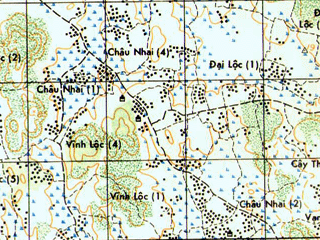
IN THE COMPANY OF HEROES This is a continuation from last week's article. Before my wife and I arrived at the reunion I was apprehensive as to how I would be received by the others, because they were all former combatants, and I was not. As it turned out, however, my anxiety was misplaced. They could not have been any kinder, helpful, or more generous or gracious to Beth and me. Our old company commander, 1st Lt. Ben Goodwyn, whom we call either “The Skipper” or “Skipper,” told me he looks on me as “A marine who lucked out.” In earlier emails I had written several of the men I had once had a dream that I would write a book one day about Charlie Company's time in Vietnam. And, mind you, this dream came to a person (me) who has never written a book. My major in college was in finance, and not journalism. I told them my writing skills were mediocre at best. Furthermore, I related to several of them that I thought if a book ever did come into being it would probably be a self published book that would only be of interest to them or their families. In addition, I stated that sales of any book to the public would probably run from sparse to very few, and it would be a project this writer would probably have to self-finance and be lucky to break even on. The corpsmen and marines at the reunion could not have been any more open and honest with their individual stories, however. They showed and told me of their wounds -- both physical and emotional -- they suffered in battle in Vietnam. Many of my friends in the company were killed in the action that day. Four of the eleven men killed in battle I had once served with in my old 2nd platoon. In addition to eleven men being killed, another 51 were wounded, and in just the space of about two hours. Are you beginning to understand now how intense and violent this conflict was? One of the four men from my old platoon who was killed in action was my best friend in the service, Sgt. Pete Padilla. Somehow -- and I cannot explain it fully, because I don't understand it all myself -- I think my guilt is at least a part of the emotions that drive me so, and nudge me to take on this task. By March 28, 1966, after just seven months of combat the company had dwindled in strength, because of sickness, debilitation and wounds, from approximately 190 men down to 110. And in this total were several replacements. A number of the new men had only joined the company a few weeks before the big fight, and some of them had just recently graduated from boot camp. And a few of these new, green troops, unfortunately, were destined to die in the battle. A US Navy Corpsman, Petty Officer Robert R. Ingram, was awarded the Medal of Honor for his actions in combat on that March day. He was shot four times, including, and this was early in the fight, once in the face, which blinded him temporarily in one eye. He thought he was going to die as the result of this wound. In spite of the probability of his own impending death, he continuously ministered to wounded naval corpsmen and marines all the while. He also continued to fight and kill the enemy. Unceasingly he moved across the battlefield and aided others until he drifted into personal shock and a wounded semi-stupor. His iron will and devotion to treating his comrades still caused him, however, to refuse to be evacuated. He told me that after he was shot in the face early in the fight he no longer believed he would live, and this angered him, and inspired in him an even greater will to fight. This grievous and terrible head wound eventually caused facial tissue, sinus and bloody gore to cascade down the front of his body to the point he became unrecognizable, even to his friends. Late in the fight he passed out, almost bled out, and was tossed on the dead pile. He was discovered to be barely alive at a rear naval emergency hospital unit. This hero told me he feels guilt today because he "Was not able to do more for my friends." I told this man that when I read the c itation that accompanies his Medal of Honor it brings, even today, unbidden, tears to my eyes. In addition to the Medal of Honor two other marines were awarded the Navy Cross -- our nation's second highest decoration for heroism under fire -- in this action. Both men laid their lives on the line -- one in organizing, protecting and caring for his wounded men and refusing to be evacuated even after being wounded. Sgt. Wayne Fowler knocked out the same enemy machine gun three times. That particular machine gun had been manned time and again by another crew after each marine assault. The other marine awarded the Navy Cross, Pfc. Al LaPointe, armed with only grenades and a bayonet, assaulted an enemy antiaircraft gun crew. He killed all the gun crew and even chased down and killed a soldier who fled into and down an underground tunnel. In addition, several other marines were awarded the Silver Star for this action. This medal is our nation's third highest award for heroism in battle. As I've stated before I know of only six men from Henry County who have ever been awarded this prestigious medal, in all of our nation's wars, and it is my belief that less than fifteen men from Henry County have ever earned this award. Another Navy corpsman, Robert Shelly, in the same action -- which the marines call Operation Indiana -- was kneeling over and aiding a wounded marine on the battlefield when a Vietnamese antiaircraft shell burst hit him on his back. The tissue, muscle, blood and skin from his wound was blown up his back, he told me, and over his head and into his face. This rendered him, temporarily, of being unable to see. He related he spent years in Naval hospitals and endured several surgeries and a painful rehabilitation. His devoted wife Sue moved to whatever city the navy medical facilities were located as the Navy moved him from one hospital to another. Each time they moved her husband to another city she found a new job to support herself. She visited and sat with her husband daily, while she ministered to, loved and encouraged him. When I asked this man if he felt God had a hand in what happened to him he answered "Yes, I do," and said he was "Grateful and thankful to God for his life.” He further related he “Thinks God invoked His Divine Plan into his life, and is grateful to our Creator because of it." This same man, whose body was partially paralyzed for almost a year, and now walks with a cane, feels guilt for having been wounded and not been able to tend more of his friend's wounds on the battlefield. When I think of what this tall and gentle man and his wife endured, and of the courage, determination and fortitude both he and his wife exhibited -- and of how his wife supported him, both with emotional support and extreme and diligent faithfulness through their combined suffering, sorrow and grief - it is easy for tears to well in my eyes in awe and admiration of them. This series will be continued next week. Copyright, May 5, 2005, by M. K. Bedsole.
The writer of these articles may be contacted at : |